Deni Lantz: pinturas, Ivo Mesquita (2022)
Deni Lantz: Paintings, Ivo Mesquita (2022)
O pintor Deni Lantz gosta de samba. Ou melhor, ele é também músico instrumentista, de roda de samba, com apresentações públicas, além de um cidadão com amplo interesse por hortas, agricultura, florestas renováveis. Sim, ele pinta paisagens de observação direta, depois memórias delas e de interiores, quase- naturezas-mortas, mas pode-se dizer que sua pintura é abstrata; antes um conceito e uma prática do que um tema narrativo. Daí que, nesse circular entre ambientes diversos, sua produção pictórica pode ser percebida como se uma reflexão profunda sobre a pintura fosse perturbada por uma desordem exterior a ela, e, ao mesmo tempo, o contrário disso, a desordem exterior é que é mitigada na profundidade da reflexão. Para ele a pintura é uma narrativa espiritual indeterminada em camadas de afeto e sentido.
Graduado em artes visuais pela Unicamp, Lantz, na adolescência, frequentou a Casa da Xiclet, espaço alternativo e de artistas emergentes na Vila Madalena, em São Paulo; aprendeu a pintar retratos com Juan José Balzi (1933-2017), quando descobriu Rembrandt e Velásquez, e, posteriormente, já na universidade, aprofundou-se nesta arte (retrato) e na gravura, trabalhando com Ernesto Bonato (1968). A originalidade do seu trabalho reflete esse trânsito do artista entre o mundo real, sua experiência direta e avassaladora, e um mergulho profundo na materialidade silenciosa das cores, no manuseio solitário dos meios, no gesto obsessivo e na repetição do fazer. A pintura abstrata, por sua vez, dispensa qualquer relação inequívoca entre significante e significado, o que a aproxima de um outro sistema artístico, a música. Não por acaso ambas as disciplinas emprestam vocabulário uma à outra quando falam de ritmo, expressão, gesto, composição, dinâmica, coloratura, tons e linhas, entre outros. A relação entre elas está na origem da obra e do pensamento do primeiro pintor abstrato, Wassily Kandinsky.
O conjunto de trabalhos que constitui esta primeira mostra do artista foi produzido entre 2020 e 2022, isto é, durante a pandemia. Não se pretende com ele, no entanto, um comentário sobre ela, mas sim marcar a circunstância em que se desencadeou o processo de pensar e produzir essas pinturas, o que incluiu sessões de ateliê virtual com Paulo Pasta. Daí a predileção pelos pequenos formatos, favoráveis ao registro rápido e à experimentação, trabalhados como páginas de um diário sempre aberto, com dias inacabados. Com uma paleta baseada no branco, verde, escarlate e azul – pastosos ou liquefeitos em cera, puros ou sujos como bad painting –, as telas se alinharam na parede do estúdio como folhas arrancadas de um calendário improvável, uma vez que se redesenhava não apenas pelas novas telas que surgiam a cada dia, mas sobretudo por aquelas de dias passados retrabalhadas como um novo presente.
Uma cumbuca, entre outros apetrechos similares e diversos nas mesas do ateliê, de repente, destacava sobre o plano uma forma e suas sombras. A extensa serie das Cumbucas, quase sempre em formatos quadrados, tinta e cera e trabalhadas com espátula e pincéis curtos e duros, liga o vazio entre representação e abstração por meio de uma simplificação de formas e cores tendendo ao monocromo, mas com intensidades diferentes que vão da transparência opaca, como nas aquarelas, até uma saturação do plano com sucessivas camadas de pintura e procedimentos que selam tudo abaixo na superfície texturada como um improviso musical. A individualidade de cada uma das imagens reside no amplo leque de atmosferas que desvelam: ásperas, oníricas, sujas, elegantes, irônicas, leves, profundas. Constituem-se como uma écriture: a pintura como um signo que fala da sua constituição material – forma, cor e gesto (escrita) – para a integração sintática da imagem como um todo. O que também pode ser percebido em outra série, Drink, onde uma ideia de copo marca limites entre gestos diversos com o pincel e a cor, flutuando entre abstração total de pinceladas e matéria e a sugestão visual de alguma coisa familiar ou recordada. Lantz não procura algo na pintura, mas em vez disso espera que algo seja encontrado lá.
Outra referência importante nas ruminações pictóricas do artista também pode ser vista no estúdio: uma mesa e a sombra diagonal dos seus pés. Embora essas linhas apareçam em diferentes tamanhos, elas são mais perceptíveis nos formatos maiores, pois estruturam os planos que recebem mais ou menos quantidade de matéria pictórica e determinam o ritmo, a intensidade e a extensão do gesto do artista com o pincel em cada uma das partes, como pode ser visto, por exemplo, nas evocativas e monocromáticas Sem título (paisagem laranja) e Sem título (paisagem rosa).
Mas é o monocromo, o idioma da arte contemporânea, na sua interpretação dele e da tradição que representa na pintura moderna, que Lantz parece ter como questão privilegiada pela sua prática. Por certo não lida com a pureza e o essencialismo dos mestres como Rothko, nem com o cinismo industrial e libertador de Warhol. Ele constrói o seu. São superfícies feitas de muitas camadas sobrepostas de gestos, pentimentos, apagamentos, nuançado, numa superfície densa como o Sem título (magenta) ou então como em Pérolas, calos das conchas / e Il, ambos cobertos por um branco saturado, tátil e movimentado como a formação de nuvens, entre opaco e luminoso. Lantz aposta na exploração física da pintura, na sensação visual entregue pela cor.
Em alguns trabalhos Lantz põe em jogo a fisicalidade da pintura como um objeto ao mesmo tempo que uma imagem, enfatizando a sua gestalt à maneira dos minimalistas. Ele estende a pintura para as laterais da tela. Essa espécie de terra de ninguém, deixada de lado, quase sempre descartada pelos artistas e cobertas por molduras, serve para ele acentuar a materialidade e a autonomia do objeto, assim como problematizar sua relação com a parede e a primazia do olhar frontal na pintura, pois obriga o observador a deslocar-se para uma visão diagonal do plano pictórico. Como se o trabalho reagisse mais intensamente à parede que trabalhos confinados em uma moldura. Daí que na exposição trabalhos com ou sem moldura são uma decisão do artista. Trata-se de responsabilidade estética.
O artista e pintor português Julião Sarmento, falecido no ano passado, disse certa vez em uma entrevista: “Então, a pintura está morta?! Tudo bem. Isto quer dizer que podemos fazer o que quisermos”. A fotografia, o cinema, a instalação ou qualquer outro meio não mataram a pintura; tampouco a arte conceitual e a crítica institucional a enterraram. A pintura persiste a despeito e por causa da sua longa história, algo tão rico, complexo e sempre cativante. Ela é parte do mundo real. Como a música e a paisagem.
Ah, em tempo, junto com a primeira exposição do Deni veio também à luz o Tom, o primeiro filho do artista.
Alegria, alegria!
Painter Deni Lantz likes samba. Or rather, he is also an instrumental- ist and singer of samba and drum carrying public exhibitions. He is a citizen with a wide interest in vegetable gardens, agriculture and renewable forestry. Yes, he paints landscapes from direct ob- servation more than from memory, and country sides almost as still lives. But one can say that his painting is abstract; a concept and a practice more than a narrative theme. Hence, in this movement between different environments, his work can be perceived as if a deep reflection on the paintings were disturbed by an external dis- order and, at the same time, the opposite is the case. The external disorder is mitigated in the depth of reflection. For him, painting is an indeterminate spiritual narrative layered with affection and meaning.
Graduated in Visual Arts from Unicamp as a teenager, Lantz frequently attended Casa da Xiclet, an alternative space for emerging artists at Vila Madalena, in São Paulo. He learned how to paint portraits with Juan José Balzi (1933-2017) when he discovered Rembrandt and Velásquez. Later while in college, he delved into this art and also engraving while working with Ernesto Bonato (1968). The originality of his work reflects the artist’s transition between the real world of his direct and overwhelming experience and a deep dive into the silent materiality of colors that included the solitary handling of media, the obsessive gesture and the repetition of doing. Abstract painting in turn dispenses with any unequivocal relationship between signifier and signified which brings it closer to another artistic system: music. It is not by chance that both disciplines lend vocabulary to each other when they talk about rhythm, expression, gesture, composition, dynamics, coloratura, tones and lines, among other things. The relationship between them is at the origin of the work and thought of the first abstract painter, Vassily Kandisnky.
The set of works that constitute this first show by the artist was produced between 2020 and 2022. This is during the pandemic. It is not intended, however, to be a comment on it, but rather to mark the circumstance in which the process of thinking and producing these paintings began, which included virtual studio sessions with Paulo Pasta. Hence the predilection for small formats, favorable to a quick recording and experimentation. They worked like pages of a diary that is always open with unfinished entries. Containing a palette based on white, green, scarlet and blue – pasty or liquefied in wax, pure or dirty like bad painting – the canvases lined up on the studio wall are like pages ripped from an unlikely calendar. It is as if it was redrawn not only by the new canvases that appeared every day, but above all from days gone by, reworked as a new present.
A bowl, among other similar and diverse objects on the tables in the studio, suddenly highlighted a shape and its shadows on the plane. The extensive series of Cumbucas (Bowls), almost always in square, ink and wax formats and worked with a spatula and short, hard brushes, bridges the gap between representation and abstraction through a simplification of shapes and colors tending to monochrome. However, they have different intensities that range from opaque transparency as in watercolors to a saturation of the plane with successive layers of paint and procedures that seal everything below the textured surface like a musical improvisation. The individuality of each of the images resides in the wide range of atmospheres they reveal: rough, dreamy, dirty, elegant, ironic, light and deep. They are constituted as an écriture: the painting as a sign that speaks of its material constitution – form, color and gesture (writing) – for the syntactic integration of the image as a whole. This can also be seen in another series: Drink. It is where an idea of a glass marks boundaries between different gestures with the brush and color, floating between the total abstraction of brushstrokes and matter and the visual suggestion of something familiar or re- membered. Lantz doesn’t look for something in the painting but instead hopes that something will be found there.
Another important reference in the artist’s pictorial rumination can also be seen in the studio: a table and the diagonal shadow of its feet. Although these lines appear in different sizes, they are more noticeable in larger formats. They structure the planes that receive more or less pictorial matter and determine both the rhythm, in- tensity and extension of the artist’s gesture with the brush in each one of the parts. This can be seen, for example, in the evocative and monochromatic Untitled (orange landscape) and Untitled (pink landscape).
But it is monochrome, the idiom of contemporary art, with his interpretation of it and of the tradition it represents in modern painting that Lantz seems to have made an important focus for hiswork. He certainly neither deals with the purity and essentialism of masters like Rothko nor with the industrial and liberating cynicism of Warhol. He builds his surfaces made of many superimposed lay- ers of gestures, requests, erasures, nuanced on a dense surface like Untitled (magenta) or as in Pérolas, calos das conchas I e II (Pearls, calluses from shells I and II). They are both covered by a saturated white, tactile and move like the formation of clouds, between opaque and luminous. Lantz bets on the physical exploration of painting and on the visual sensation delivered by color.
In some works. Lantz brings the physicality of painting into play, as an object at the same time as an image, emphasizing its gestalt in the manner of the minimalists. He extends the painting to the sides of the canvas. This is a kind of no man’s land, left aside, almost always discarded by artists and covered by frames. It is used by him to accentuate the materiality and autonomy of the object, as well as to contrast its relationship with the wall and the primacy of the frontal look in the painting. He forces the observer to move to a diagonal view of the pictorial plane. As if the work reacted more intensely to the wall than a work confined to a frame. Hence, in the exhibition, the decision to present works with or without frames is at the artist’s discretion. It’s about aesthetic responsibility.
Portuguese artist and painter Julião Sarmento, who died last year, once said in an interview: “So, painting is dead?! That’s ok. This means we can do whatever we want.” Photography, cinema, installation or any other medium did not kill painting; nor have conceptual art and institutional criticism bury it. Painting persists despite and because of its long history of being something so rich, complex and always captivating. It is part of the real world. Like the music and the landscape.
Ah, in time, along with Deni’s first exhibition, Tom, the artist’s first son also came to light.
Joy, Joy!
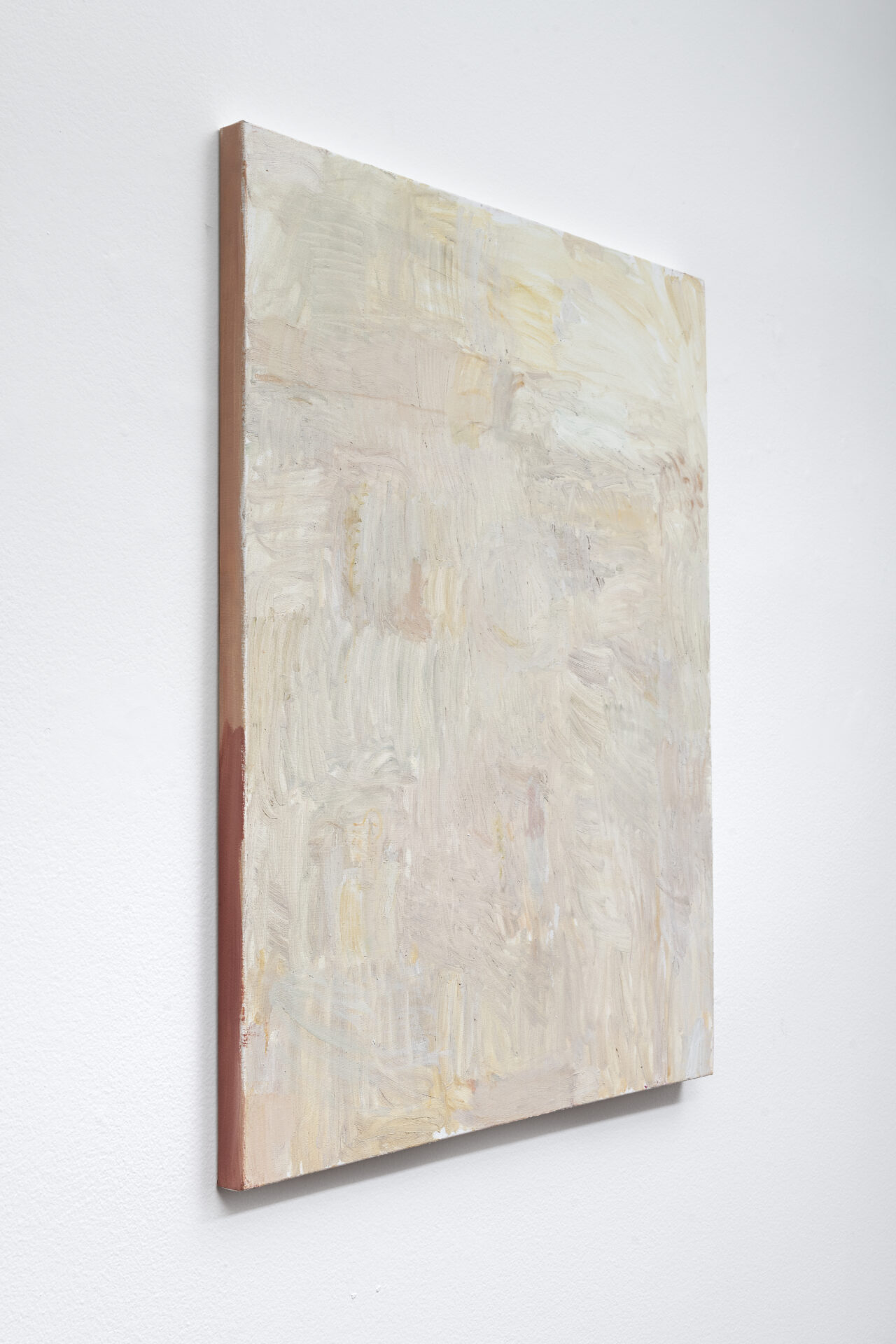
Pérolas calos das conchas II | Pearls, calluses from shells II, 2021 Óleo e cera sobre tela | Oil and wax on canvas
100 x 80 cm | 39.37 x 31.5 in