Temporalidades Materiais, por David Rhodes
E isso não tem nada a ver com a natureza no sentido do século XVIII, que era uma espécie de decoração, se quisermos, para a vida humana.
Ao passo que agora, é justamente o oposto: ela é uma parceira, entende? Não é decoração, é uma parceira. Não é um ambiente, é algo que se assemelha a nós.
Michel Serres¹
I
Para Deni Lantz, ritmo e rotina são a forma do seu dia, da sua vida. Em São Paulo, em casa e com sua família, os ritmos cotidianos são familiares; durante sua permanência em Nova York, uma nova rotina tornou-se necessária. A curta caminhada do lugar onde estava hospedado até seu ateliê temporário, seguida de longas horas ali, combinadas com visitas a museus e galerias. Embora viva em um ambiente urbano no Brasil, ele passou muito tempo em contato com a natureza — sua mãe é conservacionista, seu pai veterinário — e essa experiência de viver em meio a uma floresta em crescimento, a complexidade da mudança contínua — cor, som, luz, movimento e cheiro — permaneceu central para sua experiência e concepção de mundo. A natureza não é, para Lantz, um tema de dissociação, como é para tantos habitantes das cidades; muito pelo contrário.
Além de pintor, ele também é músico de samba. Toca tamborim e cavaco, ou “cavaquinho”, um pequeno instrumento brasileiro de quatro cordas usado no samba e no choro. O primeiro (tamborim) é percussivo, pontos e marcas sonoras; o segundo é melódico e harmônico. O samba é uma experiência coletiva, geralmente executada junto a outros músicos e a um público. Já a composição musical, por outro lado, é solitária, muito semelhante ao trabalho de uma pintura no ateliê. Em ambos os casos, o ouvinte ou o espectador forma uma espécie de comunidade: há comunicação por meio de estruturas de cor, contraste, ritmo e textura, assim como de palavras — há uma tatilidade específica tanto no timbre de um instrumento musical quanto na superfície de uma pintura.
A geração de artistas brasileiros que incluiu Lygia Clark, Lygia Pape e Hélio Oiticica buscou um aspecto social para a arte, com a participação direta do público; a fruição de pinturas como as de Lantz também pode ser participativa, ainda que permaneçam simplesmente pinturas na parede. A instalação das obras na High Noon Gallery, em Nova York, incentivava uma observação ativa, em vez de passiva: a mudança sutil e rítmica de escala, desde trabalhos de formato íntimo até obras diante das quais se podia ficar muito próximo e que então ocupavam todo o campo de visão, criava uma conexão corporal com a superfície da pintura, de bela fatura.
Essa fatura é alcançada pela aplicação de pinceladas repetidas e raspagens da superfície, que pulsam e revelam camadas anteriores, sendo assim indiciárias do tempo e do processo — algo típico de todas as pinturas de Lantz, grandes ou pequenas. A escala das pinturas, externamente, nesse friso de obras de diferentes tamanhos, possuía tanto um ritmo relacional próprio, de uma em relação à outra, quanto internamente um outro ritmo: a relação de escala entre as partes e o todo era sentida como um movimento adicional, como respiração ou batimento cardíaco — prolongando a articulação das pequenas pinceladas, mas por outros meios. O título apropriado da exposição, Keeping Time, faz referência à estrutura musical e a uma noção metafísica de uma temporalidade sustentada, mas não imobilizada.
Os sons nos conduziram à música e à linguagem, e a própria natureza constitui uma linguagem, sua matéria-prima: ruído, repetições, volume; a insistência das ondas batendo na costa, das folhas farfalhando ao vento. Ainda é subestimada a importância de parar de nos vermos como o centro do universo, com nossa linguagem determinando tanto nossa superioridade quanto nossa separação. O filósofo Michel Serres defende que podemos transpor distinções como animal e mineral, ser e matéria, e compreender o tempo como não linear, propondo que ele seja recursivo, feito de redemoinhos, correntes e flutuações. Assim como Matisse tinha consciência da fenomenologia, em nosso tempo Lantz atravessa categorias com suas pinturas, reunindo os sentidos da visão, do som e do tato.
II
“Não é uma mensagem de ideias que lhes transmito, mas um êxtase instintivo daquilo que está oculto na natureza…” ²
“No instante seguinte, sou eu que faço? ou isso se faz sozinho?” ³
Clarice Lispector
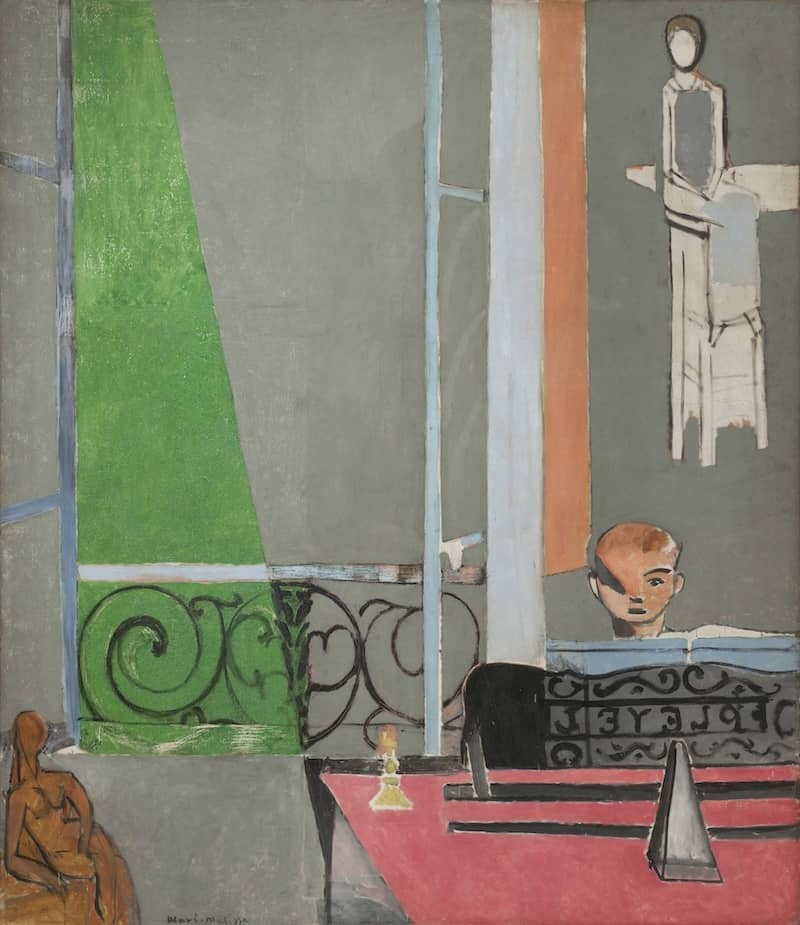
Lantz fez repetidas visitas para ver A Lição de Piano, de Henri Matisse, concluída em sua casa/ateliê em Issy-les-Moulineaux, no final do verão de 1916, hoje na coleção do Museu de Arte Moderna de Nova York. O verde exuberante do jardim penetra o cinza do interior; a moldura da janela tem a tinta raspada, com camadas expostas, repetidas à medida que a pintura avançava no tempo, deixando um rastro rítmico. O menino é Pierre, filho de Matisse (Lantz também tem um filho pequeno), sentado ao piano, com seu instrutor atrás dele. As passagens de cor atravessam as figuras, a arquitetura e a natureza do jardim sem distinguir as figuras humanas como separadas do mundo em que existem. Música e pintura coabitam.
As composições de Lantz, nem figurativas nem abstratas, são coisas vibrantes em si mesmas, independentes, mas intimamente conectadas ao mundo, jamais o representando como inerte ou distante.
Material Temporalities, by David Rhodes
And this has nothing to do with nature in the eighteenth-century sense, which was a kind of decor, if you will, for human life.
Whereas now, quite the opposite: It’s a partner, you see? It’s not decor, it’s a partner. It’s not an environment, it’s something that resembles us.
Michel Serres
I
For Deni Lantz rhythm and routine is the shape of his day, his life. In São Paulo at home and with his family, the rhythms of the day are familiar: during his stay in New York City a new routine was necessary. The short walk from where he was staying to his temporary studio, then long hours there, together with visits to museums and galleries. Though he lives in an urban environment back in Brazil he has spent a lot of time in nature—his mother is a conservationist, his father a veterinarian—and this experience of a living amongst a growing forest, the complexity of continuous change: color, sound, light, movement, and scent, has remained important to his experience and conception of the world, nature is not a subject of dissociation for Lantz, as it is for so many city dwellers, quite the opposite in fact.
Besides being a painter he is also a Samba musician. He plays the tamborim, and the cavaco, or “cavaquinho”, a small, four-string Brazilian guitar used in samba and choro music. The first percussive, dots and points of sound, the second melodic, harmonious. Samba music is a collective experience, usually performed together with other players and an audience. However, the composing of music is on the other hand solitary, it is much like working on a painting in a studio. In both cases, the listener or viewer form a kind of community: there is communication, using structures of color, contrast, rhythm, texture as well as words—there is a specific tactility in the timbre of both a musical instrument, and the surface of a painting.
The generation of Brazilian artists that included Lygia Clark, Lygia Pape, and Hélio Oiticica saught a social aspect for art with direct participation of an audience; viewing paintings like Lantz’s can be participatory too, whilst remaining simply paintings on a wall. The installation of paintings at High Noon Gallery in New York encouraged an active rather than passive viewing: the subtle, rhythmic change of scale from intimate sized works up to works that one could stand close to and which then occupied the whole field of vision, making for a bodily connection the painting’s surface of beautiful facture.
This facture is achieved by application of repeated brush marks and surface scrapings that pulse and reveal previous layers, and so indexical of time and process—something typical of all Lantz’s paintings, large or small. The scale of the paintings externally in this frieze of various sized paintings had both their own relational rhythm, one to another, and internally, another rhythm: the scale of parts to whole felt like additional movement, like breathing or a heartbeat—continuing the articulation of the small brush strokes themselves, but with other means. The apt title for the exhibition Keeping Time, references musical structure, and a metaphysical notion of held, but not stilled, temporality.
Sounds have led us to music and language, and nature itself constitutes a language, its raw material: noise, repetitions, volume; the insistence of waves lapping a shore, leaves rustling in wind. It is underappreciated still just how important it is to stop seeing ourselves as the center of the universe, our language determining both our superiority and our apartness. The philosopher Michel Serres contends that we can bridge distinctions such as animal and mineral, being and matter and view time as non-linear, proposing that it is recursive, made up of eddies, currents and fluctuations. As Matisse was aware of phenomenology, in our time Lantz bridges categories with his paintings, bringing together the senses of sight, sound and touch.
II
This is not a message of ideas that I am transmitting to you, but an instinctive ecstasy of whatever is hidden in nature…”
“The next instant, do I make it? or does it make itself?”
Clarice Lispector
Lantz made repeated visits to see Henri Matisse’sThe Piano Lesson, completed at his home/studio at Issy-les-Moulineaux, during the late summer of1916 in the collection of The Museum of Modern Art, New York. The verdant green of the garden penetrates the grey of the interior, the window frame is scaped paint, layers exposed, repeated as the painting progressed through time leaving a rhythmic trace. The boy is Matisse’s son, Pierre (Lantz too, has a young son) who sits at a piano, his instructor behind him. The passages of color passage through the figures, architecture and nature of the garden without distinguishing the human figures as separate from the world in which they exist. Music, and painting co-habit.
In Lantz’s compositions, not figurative, not abstract, are vibrant things in themselves, independent, whilst intimately connected to the world, never rendering it as inert, distant.
Outra pintura de Matisse que afetou profundamente Lantz no MoMA é Janela com Cortina Amarela (originalmente intitulada Composição), de 1915, uma vista da mesma casa de A Lição de Piano. Trata-se de uma pintura que dissolve a distinção entre as coisas vistas e as coisas parcialmente representadas, agora reimaginadas como memória, como outra coisa, como pintura — assim como Lantz faz em suas próprias obras. Tal como as zonas de cor nas pinturas de Lantz, os campos cromáticos de Matisse são estabelecidos com um pincel pequeno, cujos movimentos seguem direções diversas, ritmicamente vivos à nossa percepção.
Ao longo da borda vertical esquerda da pintura há uma inclinação de preto. Essa forma/linha imprimiu uma sensação tão forte que Lantz transferiu uma inclinação semelhante para várias de suas próprias pinturas: Cavaco Bandola (2024), Land 2 (2024) e Cacao (2024), nas quais a linha preta aparece agora no lado direito da pintura. Lantz utiliza uma mistura de tinta a óleo, majoritariamente da marca Joules & Joules, fabricada em São Paulo, e cera de abelha, aplicada com um pincel pequeno; vemos como as camadas, frequentemente raspadas e repintadas, conectam momentos da história de sua feitura: retraçando, em um arco temporal não linear, uma materialidade que incorpora o tempo em repetições que marcam sua passagem.
As composições aninham formas retangulares, como recipientes ou janelas; divisões assimétricas, às vezes parciais, sugerem por vezes a continuação da forma para além da borda física da pintura, enquanto em outros momentos uma forma é encerrada dentro de outra. Pontuações frequentes — pequenos pontos ou marcas semelhantes a sementes — se agrupam e modulam campos de cor, articulando um ritmo distinto, em contraponto ao plano da superfície da pintura, enquanto a estrutura pictórica é ritmada pelo movimento do pincel. A forte ressonância das pinturas de Deni Lantz permanece com o espectador muito tempo depois da observação; parafraseando Lispector desta vez e substituindo a escrita pela pintura: “Pintar é uma pedra lançada em um poço profundo.”
¹ O filósofo francês Michel Serres, de uma entrevista com Paul Galves na Artforum, setembro de 2022 (Vol. 52, nº 1).
² A autora brasileira Clarice Lispector, de seu romance Água Viva (1973). New Directions (2012).
³ Clarice Lispector, de seu romance Um sopro de vida: pulsações (1978). New Directions.
Another Matisse painting that affected Lantz deeply at MoMA is Le Rideau jaune (Window with a Yellow Curtain) – originally titled Composition by Matisse,of 1915, a view from the same home in The Music Lesson. It is a painting that dissolves the distinction between things seen, and things partially represented, but now reimagined, as a memory, as another thing, as a painting: much as Lantz does in his own paintings. Like the zones of color in Lantz’s paintings, Matisse’s fields of color are established using a small brush, the movements of which move in different directions, rhythmically alive to our perception.
Along the left vertical edge of the painting is a slant of black. This shape/line impressed a sensation to such an extent that Lantz transferred a similar slant shape/line to several of his own paintings: Cavaco Bandola, 2024, Land 2, 2024, and Cacao, 2024, where the black line now appears on the right side of the painting. Lantz uses a mixture of oil paint mostly the brand Joules & Joules, manufactured in Sao Paulo, and beeswax applied with a small brush, and we see the often scraped off and repainted to layers connect moments in the history of their making: retracing in a nonlinear temporal arc that materially embodies time in repetitions that tap out time.
Le Rideau jaune (Composition), 1915, by Henri Matisse.
Compositions nest rectangular shape: like vessels or windows, asymmetrical divisions sometimes partial, implying more of the shape beyond the painting’s physical framing edge at other times enclosing one shape within another. Frequent punctuations: small dot or seed-like marks gather in and inflect fields of color, articulating a different rhythm counterpoint to the surface plane of the painting, the pictorial structure rhythmed by movement of the brush. The strong resonance of Deni Lantz’s paintings stays with the viewer long after viewing, to misquote Lispector this time and substitute painting for writing “Painting is a stone cast down a deep well.”